
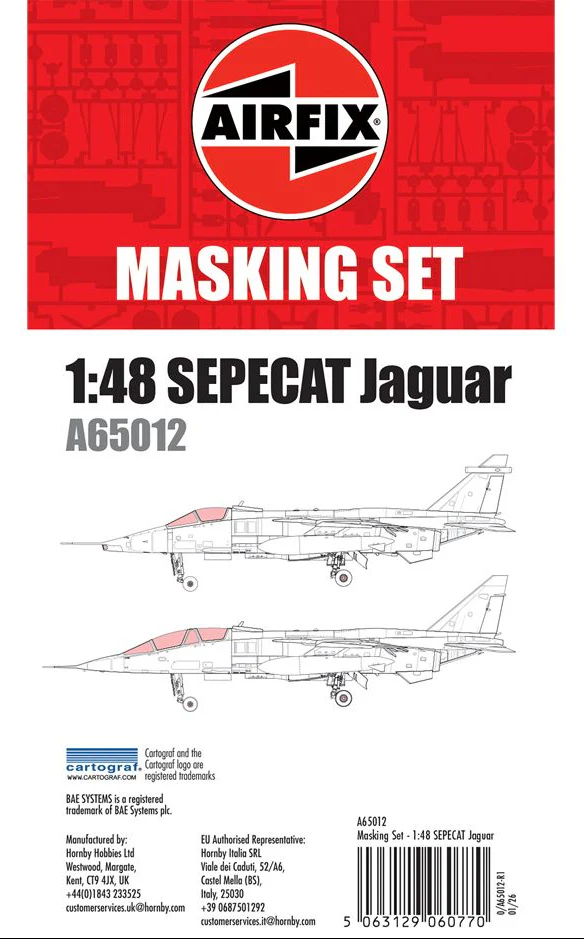
A65012 Masking Set - SEPECAT Jaguar
Expected Delivery June 2026 (Subject to Change at Manufacturer's Discretion).
Product Info
Simplify the painting process of your model kits with the Airfix Masking Set tailored for the 1:48 scale SEPECAT Jaguar model. Crafted for accuracy and convenience, these pre-cut adhesive masks enable you to create crisp paint lines on canopies, clear sections, and other challenging areas, eliminating the need for freehand painting or airbrush techniques. Custom-fitted to the specific Airfix model, they save you time, enhance precision, and provide a professional finish. By using CAD data from the model design, these masks ensure every curve and contour is captured with precision.
Key Features
- Pre-cut adhesive masks specifically designed for the 1:48 scale SEPECAT Jaguar model kit
- Easily achieve crisp, professional paint lines on canopies and clear parts
- Created using CAD data from the original model kit design for an impeccable fit
- Removes the necessity for freehand painting or intricate airbrush masking
- Saves time and enhances precision for a superior finish
History
The SEPECAT Jaguar emerged from a joint Anglo-French initiative, intended as a supersonic tactical support and strike aircraft. Its maiden flight was in 1968, and it entered service with both the Royal Air Force and the French Air Force in the early 1970s. Developed by SEPECAT, a collaboration between British Aircraft Corporation and Breguet, the Jaguar was initially designed as an advanced jet trainer but evolved into a formidable ground attack aircraft. The RAF operated the Jaguar GR.1 and its reconnaissance version, the GR.1A, while the French used the Jaguar A for ground attack and the Jaguar E as a two-seat trainer. Known for its distinctive angular design and powerful twin-engine setup, the Jaguar participated in numerous combat operations, including the Gulf War, the Balkans conflict, and missions over Iraq. Its robust design, excellent low-level handling, and precision strike capabilities made it a valuable asset for both air forces. British Jaguars were retired from RAF service in 2007 after more than thirty years, while French Jaguars remained in service until 2005, eventually replaced by newer aircraft like the Rafale.
What's Inside
- Paint masking set
Original: $13.40
-65%$13.40
$4.69Product Information
Product Information
Shipping & Returns
Shipping & Returns
Description
Expected Delivery June 2026 (Subject to Change at Manufacturer's Discretion).
Product Info
Simplify the painting process of your model kits with the Airfix Masking Set tailored for the 1:48 scale SEPECAT Jaguar model. Crafted for accuracy and convenience, these pre-cut adhesive masks enable you to create crisp paint lines on canopies, clear sections, and other challenging areas, eliminating the need for freehand painting or airbrush techniques. Custom-fitted to the specific Airfix model, they save you time, enhance precision, and provide a professional finish. By using CAD data from the model design, these masks ensure every curve and contour is captured with precision.
Key Features
- Pre-cut adhesive masks specifically designed for the 1:48 scale SEPECAT Jaguar model kit
- Easily achieve crisp, professional paint lines on canopies and clear parts
- Created using CAD data from the original model kit design for an impeccable fit
- Removes the necessity for freehand painting or intricate airbrush masking
- Saves time and enhances precision for a superior finish
History
The SEPECAT Jaguar emerged from a joint Anglo-French initiative, intended as a supersonic tactical support and strike aircraft. Its maiden flight was in 1968, and it entered service with both the Royal Air Force and the French Air Force in the early 1970s. Developed by SEPECAT, a collaboration between British Aircraft Corporation and Breguet, the Jaguar was initially designed as an advanced jet trainer but evolved into a formidable ground attack aircraft. The RAF operated the Jaguar GR.1 and its reconnaissance version, the GR.1A, while the French used the Jaguar A for ground attack and the Jaguar E as a two-seat trainer. Known for its distinctive angular design and powerful twin-engine setup, the Jaguar participated in numerous combat operations, including the Gulf War, the Balkans conflict, and missions over Iraq. Its robust design, excellent low-level handling, and precision strike capabilities made it a valuable asset for both air forces. British Jaguars were retired from RAF service in 2007 after more than thirty years, while French Jaguars remained in service until 2005, eventually replaced by newer aircraft like the Rafale.
What's Inside
- Paint masking set


