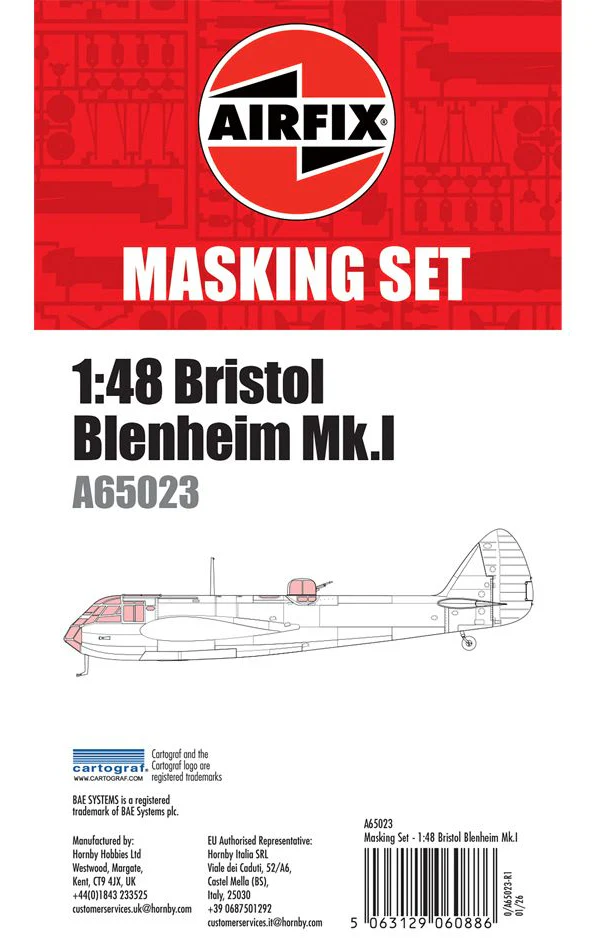
A65023 Masking Set - Bristol Blenheim Mk.I
Expected Delivery Q3 2026 (Subject to Change at Manufacturer's Discretion).
Product Info
Enhance your 1:48 scale Bristol Blenheim Mk.I model with precision painting using this specially crafted Airfix Masking Set. These adhesive masks are pre-cut to perfectly match the unique contours of your model, using CAD data from the original kit design to ensure precise shapes for canopies, clear parts, and other intricate areas where crisp paint lines are crucial.
Key Features
- Adhesive masks pre-cut specifically for the Bristol Blenheim Mk.I model
- Eliminates the complexity of freehand painting or intricate airbrush masking
- CAD-designed shapes guarantee a perfect fit for canopies and clear components
- Saves time and enhances precision in the painting process
- Provides professional-grade paint lines on difficult sections
- Suitable for ages 8 and above
History
The Bristol Blenheim marked a significant advancement in aviation technology when it joined the Royal Air Force in 1937. Initially developed from the Bristol Type 142 Britain First, a high-speed executive aircraft commissioned by newspaper magnate Lord Rothermere, its performance impressed the Air Ministry by surpassing the speed of contemporary RAF fighters. The military version became the Blenheim Mk.I, a light bomber featuring an all-metal stressed-skin structure and retractable landing gear, making it one of the most modern aircraft of its time. The Blenheim Mk.I was powered by two Bristol Mercury VIII radial engines, each delivering 840 horsepower, enabling a top speed of approximately 285 mph at 15,000 feet. The glazed nose offered excellent visibility for the bomb aimer and navigator, while the pilot was positioned in a raised cockpit behind the wing. Defensive armament included a forward-firing .303 Browning machine gun in the port wing and a .303 Vickers K gun in a semi-retractable dorsal turret operated by the air gunner. The internal bomb bay could accommodate up to 1,000 pounds of bombs. In the late 1930s, the Blenheim Mk.I equipped many RAF squadrons and was seen as a formidable weapon. However, by the start of the Second World War in September 1939, advancements in fighter design had made it vulnerable. Despite this, Blenheim squadrons conducted some of the initial RAF operations of the war, including reconnaissance missions and the first British bombing raid on Germany. The aircraft saw extensive service in the early years of the conflict across various theatres, including France, the Middle East, and North Africa, where its long range was advantageous. A Blenheim Mk.I of No. 600 Squadron achieved the RAF's first aerial victory of the war on 26 September 1939. Although eventually replaced by more advanced versions like the Blenheim Mk.IV with its extended nose and more powerful engines, the Mk.I remained in service into 1942 in some operational areas. Many were also converted to fighter variants, equipped with a belly pack containing four additional .303 machine guns for night fighter and anti-shipping roles. The Blenheim's role during the pivotal early years of the war, despite its increasing obsolescence, secured its status as a significant aircraft in RAF history.
What's Inside
- Paint masking set
Product Information
Product Information
Shipping & Returns
Shipping & Returns
Description
Expected Delivery Q3 2026 (Subject to Change at Manufacturer's Discretion).
Product Info
Enhance your 1:48 scale Bristol Blenheim Mk.I model with precision painting using this specially crafted Airfix Masking Set. These adhesive masks are pre-cut to perfectly match the unique contours of your model, using CAD data from the original kit design to ensure precise shapes for canopies, clear parts, and other intricate areas where crisp paint lines are crucial.
Key Features
- Adhesive masks pre-cut specifically for the Bristol Blenheim Mk.I model
- Eliminates the complexity of freehand painting or intricate airbrush masking
- CAD-designed shapes guarantee a perfect fit for canopies and clear components
- Saves time and enhances precision in the painting process
- Provides professional-grade paint lines on difficult sections
- Suitable for ages 8 and above
History
The Bristol Blenheim marked a significant advancement in aviation technology when it joined the Royal Air Force in 1937. Initially developed from the Bristol Type 142 Britain First, a high-speed executive aircraft commissioned by newspaper magnate Lord Rothermere, its performance impressed the Air Ministry by surpassing the speed of contemporary RAF fighters. The military version became the Blenheim Mk.I, a light bomber featuring an all-metal stressed-skin structure and retractable landing gear, making it one of the most modern aircraft of its time. The Blenheim Mk.I was powered by two Bristol Mercury VIII radial engines, each delivering 840 horsepower, enabling a top speed of approximately 285 mph at 15,000 feet. The glazed nose offered excellent visibility for the bomb aimer and navigator, while the pilot was positioned in a raised cockpit behind the wing. Defensive armament included a forward-firing .303 Browning machine gun in the port wing and a .303 Vickers K gun in a semi-retractable dorsal turret operated by the air gunner. The internal bomb bay could accommodate up to 1,000 pounds of bombs. In the late 1930s, the Blenheim Mk.I equipped many RAF squadrons and was seen as a formidable weapon. However, by the start of the Second World War in September 1939, advancements in fighter design had made it vulnerable. Despite this, Blenheim squadrons conducted some of the initial RAF operations of the war, including reconnaissance missions and the first British bombing raid on Germany. The aircraft saw extensive service in the early years of the conflict across various theatres, including France, the Middle East, and North Africa, where its long range was advantageous. A Blenheim Mk.I of No. 600 Squadron achieved the RAF's first aerial victory of the war on 26 September 1939. Although eventually replaced by more advanced versions like the Blenheim Mk.IV with its extended nose and more powerful engines, the Mk.I remained in service into 1942 in some operational areas. Many were also converted to fighter variants, equipped with a belly pack containing four additional .303 machine guns for night fighter and anti-shipping roles. The Blenheim's role during the pivotal early years of the war, despite its increasing obsolescence, secured its status as a significant aircraft in RAF history.
What's Inside
- Paint masking set